
So you’ve heard about it on Youtube or from a friend,.. or you watched an 80’s period show like Stranger Things and were intrigued by the idea of Old School Dungeons & Dragons. After a few Google searches you were stymied in answering the question, “How can I learn to play AD&D First Edition?”.
If you were searching for Dungeons & Dragons and came upon this article without first knowing what Advanced Dungeons & Dragons is, read my article about it. Otherwise, grab yourself a drink and strap in. You’re about to embark on your new favorite hobby.
The Short Answer
If you want to be a Dungeon Master in AD&D 1e, there is no shortcut. You will need to do a lot of reading. You will need lots of experience before you will be any good at it.
Just Play
If you are interested in being a Player Character, my recommendation is to not get to tied up in too much reading, at least up front, and just play. Find a good DM with a penchant for teaching new players (like me!) that are open to mentoring newbies and jump in. Do more listening than talking early on. Get a feel for the style and tempo of the group and, once comfortable, start contributing.
Advanced Dungeons & Dragons
AD&D comes in two flavors. First Edition (1e) and Second Edition (2e). The latter has a revision sometimes referred to as 2.5e. We are concerned with 1e. The Holy Trinity of reading for AD&D are the Player’s Handbook, the Dungeon Master’s Guide, and the Monster Manual. The official manuals are disjointed at times and even contradictory among themselves once in a while. To make matters more complicated, a series of supplements like Unearthed Arcana and a variety of Class Handbooks were published at later dates. Additionally, Dragon magazine had a long series of articles in which developers and contributors explained their intentions for 1e at greater lengths or even expounded upon and added to existing systems.
To confuse things a bit more, First Edition is not the first version of Dungeons & Dragons to have been published. It is simply the first of AD&D. Advanced means, among other things, the creators went hog wild with content and systems. They really tried to develop a comprehensive framework for expressing your imagination within a universal set of guidelines.
Dungeon Master
If you want to be a Dungeon Master in AD&D 1e, you will need the Player’s Handbook and the Dungeon Master’s Guide. You will need to become well-acquainted with both. They are difficult reads, particularly the latter. The Monster Manual will round out your set of required reading.
The above will get you started. It will require lots of experience as a DM to make you good at it. I’ve seen many experienced DMs agree with the notion that Players don’t really need to do much reading. They can, and some argue should, learn by playing. The responsibility is almost exclusively upon the DM to do the reading, to develop a deep understanding of the game in order to run the players through it. This is fairly unique to AD&D First Edition.
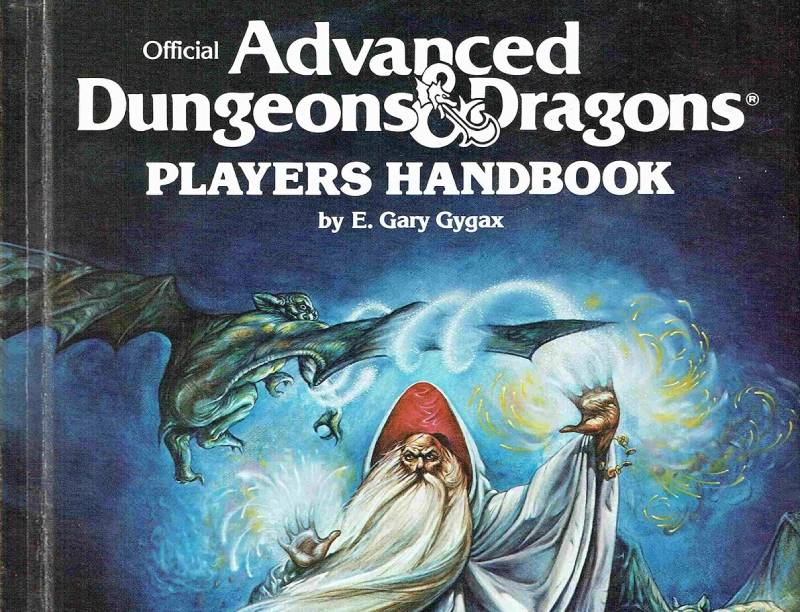
AD&D Player’s Handbook, First Edition
Please trust me when I tell you that if you really want to learn this on your own, you are going to have to read. And I mean read a lot. It’s unavoidable if you have aspirations to be a Dungeon Master (DM). Let’s assume your interest is in being a Player and therefore the first, and maybe only, manual you will need is the Player’s Handbook. This link will offer a $9.99 downloadable PDF or a variety of Hardcover options for around $20 – $30.
Though it isn’t required if you have a good DM, the PHB will give you a thorough understanding of how to build and play your character. It will be helpful to have a copy of this around, at least for a while, as a reference guide when you play. There is just too much to absorb in one read-through. With most of the game, you can lean on your DM to guide and teach you.

How to Play
Every Player represents and is represented by a Character. The fundamental values for every player character are called Abilities, or sometimes “stats”. They are namely, Strength, Intelligence, Wisdom, Dexterity, Constitution, and Charisma. They generally range in values from 3-18. Higher numbers give you bonuses. One or more of your abilities will impact most of the die rolls you make. And you do a die roll for most every action your character takes that requires the determination of a result. Fighting, parleying with potential enemies, hiring henchman, searching a room for traps or loot, picking a lock, casting a spell, negotiating with shopkeeps,.. almost everything. You also pick a race(Elf, Gnome, Human…), a class(fighter, thief, mage,…), starting weapons, armor, and equipment, and so on. Each of these will also effect die rolls and consequent results.
The Character Sheet
As you can see above, there is a lot of information to manage for your character. You need a place to record all of that information, to wit, the Character Sheet. You will manage and refer to this sheet every time you play for the lifetime of your character. In the old days, we used to record all of this information on paper. This meant a lot of work and a lot of erasing. Today we have AD&D Toolkit. Not only does AD&D Toolkit make life easy for the player to manage all of that information, but the DM has access to it also. This saves everyone a lot of time and effort.
First Edition is Roleplay Heavy
There is a lot of roleplay in 1e. Roleplay can be theatrical where participants adopt accents and racial affectations. They may use Old English and throw out the occasional, “wherefore art thou?”. Maybe they even dress up for sessions done in-person or via video chat. Roleplay can also be more functional where you simply have to make decisions based upon your character’s history, ethics, belief systems, etc. In either case, you are representing a character. Speak and take actions inline with what your character would do. Not what you would do. Get the hang of that and you’ll be fine. If you have a newbie-friendly group, they will teach you the physical mechanics, which are mostly rolling dice.
Yes, And…
Especially while you are still learning how to play, I would strongly suggest you adopt the first rule of Improv-style acting. As I said earlier, do more listening at first than talking. Listen well to what your party members are doing and saying and then find times to chime in and add to the story. Coming from a mindset of “Yes to what you just said, and then we …” is a good way to contribute to the narrative rather than confuse or detract from it. If you have real-life experience with something relevant to the action, it will be even easier to contribute. For instance if the characters are trying to hunt for food and you have experience as a hunter, you will likely have some good material to offer.
Finding a Group
The obvious next question is, “how do I find a group?”. I would wager most veterans would tell you in-person play is preferred. Hell, most everything in life is better in-person. Some might insist it is the only way to play. But most play online. I have found the latter to be a really close second, and in some ways, it has advantages.
Play In-Person
If you want to play in-person and don’t have a ready-made group of friends also interested, you have your work cut out for you. I would suggest a local library or book stores might have a lead. Sometimes a hobby store or gaming store visit can be fruitful too. There are also lots of online communities for searching out groups on Facebook or Reddit. You usually post a listing of the city and state in which you live, your level of experience, and what edition (1e) you are looking to play and someone may reach out to you with an invitation.
Play Online
Finding online games is significantly easier as you can play with anyone, anywhere in the world provided there is no language barrier. Again there are communities connecting players with DMs around the globe on all kinds of social media. Discords such as my AD&D Toolkit Discord are great for finding like-minded participants. Some Facebook groups, Reddit communities, and the like are dedicated to connecting people.
In-Person Play Materials
What materials you need to play aside from the aforementioned Player’s Handbook vary greatly depending upon whether you are playing in-person or online. If in person, you should be fine with some paper and pencil and your PHB if you have one. Someone else will likely have dice, Character Sheets, DM screens and anything else you need.
Digital Enhancements
Part of the charm of playing AD&D in person is that it requires interpersonal activity and using your brain. Huddling around a table and rolling some dice, sharing some laughs, has some seriously nostalgic value. That being said, judicious use of technology can enhance gameplay if used wisely. It can make more efficient otherwise cumbersome mechanics. I would advise everyone use AD&D Toolkit. Audio/Visual tech like TableTop Audio is likewise a great enhancement.
Online Play Materials
If online, you will likely have a few digital tools for which you need registered accounts. Do your group a favor and find out what the requirements are. Get them all registered and working before game time. Holding up your group for your own personal issue(s) is bad form. Your DM should provide links(urls) to all web applications along with codes/tokens required to connect to his/her campaign.
Virtual Table Top (VTT)
You will likely need a VTT account. This is a web application that replaces the table-top on which your materials would be for an in-person experience. Roll20.net is a popular one. Most of them are free to players. The DM might need a paid account. The VTT allows the DM to share maps with players, move character tokens around that map, roll dice, play music or sounds of ambience, and so on. Often they have video/audio sharing. If not, you might use Discord for that.
AD&D Toolkit
I will shamelessly posit that your DM would miss a huge opportunity if they were not using AD&D Toolkit. This is a digital application developed by yours truly that holds all of your character information on a digital Character Sheet. Your DM not only has access to it all, but much of the data is integrated into most of the tools that the DM uses in AD&D Toolkit, automating a plethora of mechanics that otherwise seriously encumber and slow play.
Conclusion
AD&D is about telling a collective story that all of the players and their DM write together. It is a story of action, monster-slaying, plundering riches, solving mysteries and puzzles, negotiating alliances, building strongholds and kingdoms, and anything else you all can dream up. It requires a lot of reading (at least by your DM), writing, die rolling, and imagination. The possibilities (and opportunities for adding/removing/changing rules) are literally endless, only bound by your imaginations. If you haven’t picked up on it already, the story is written in real-time. The players and DM write it together. So it is crucial to find a group that gels with your play style. It is incumbent on you to be a good team member and do your part. Most of all, have fun.
As a final note, the manuals and rules therein are guideposts and nothing more. They are all malleable. Don’t let them constrict your play. That’s the DMs job. As a DM myself, when players ask me if they “can try” something, my answer is always, “of course”. As a player you can and should try anything that makes sense to you. It is up to me, the DM, to determine the consequence of that attempt. I’ll never stop you from trying.
