
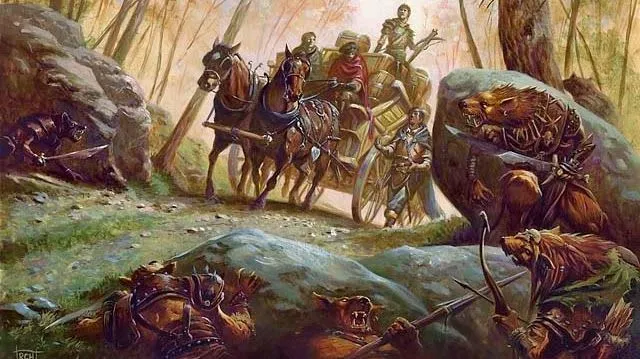
First Edition
The Surprise Calculator module will determine which, if any, parties are surprised; if surprised, for how many segments; and at what distance the encounter begins. Remember that segments are treated as rounds in the context of surprise. So if an adversary is surprised for 2 segments, the party can take 2 actions before the adversary can act.
Rolls
Random d6 rolls are provided for you but they are editable. Should you or your players wish to roll manually, just replace them.
Noise
If either party is making an exceptional amount of noise or light in ambient darkness, you can indicate that here. This will lower their chance at surprising the enemy.
Location and Terrain
Outdoor encounters yield larger distances and take into account terrain. Terrain types effect distance at which parties notice each other.
Party Surprised
As with all other fields in this module, this is editable. In regards to 1e campaigns, parties are normally surprised on a roll of 1 or 2 with a d6. Some factors are integrated automatically. If, for instance, there is a Ranger in the group, they are only surprise on a 1 in 6 and this will be reflected for you in the default value in this field.
Most Favorable Member
This “rule” applies to 1e campaigns. The DMG(1e) p61 deals with how DMs ought to process Surprise in character encounters. It notes that;
“Surprise is determined by rolling a six-sided die for each party concerned, modifying the result by using the most favorable member of the party concerned…”
The AD&D Toolkit Surprise module adheres to the 1d6 Surprise system as detailed in the DMG(1e). Espousing the Most Favorable Member rule, the AD&D Toolkit Surprise module approximates d6 representations for the percentages used with classes like the Monk and Barbarian.
Party Surprises Others
If anyone in the party has a lower chance of surprising others, it will effect the entire group. The group can only be as stealthy as its least stealthy member. If anyone has a higher than normal chance, it is on an individual basis only and does not apply to the group, for the aforementioned reason.
Second Edition
Surprise works a bit differently in 2e. If your campaign System is set to 2e, the module will adopt the appropriate ruleset. A major difference in Second Edition is that if Surprise is indicated, only 1 segment is ever lost, making it more forgiving than 1e. Distances are also calculated differently.
Rolls
Rolls are on a d10 and anything less than 4 indicates Surprise. There are a variety of positive and negative adjustments that can be applied to the roll(s) by the DM.
Which Party is Effected?
Some adjustments impact the the rolling group’s chance of being surprised. Others impact the roller’s adversary. And some impact both. As an example of the last, if the PC party is moving quickly within a dungeon setting in 2e, the party is more likely to be surprised because they are not paying as much attention to their surroundings, taking time to listen, etc. Likewise, their adversary’s chance of being surprised is reduced as the PCs are making less effort to move quietly.
Surprise Thresholds
There are four select menus (Party/Enemy Surprised and Surprises Others). Unless you have a thorough understanding of how Surprise is calculated, it is suggested you leave them alone and let AD&D Toolkit calculate them for you. In regards to 2e, they should always be set at ‘3 in 10‘ chance. Adjustments, as indicated by the DM selections, are applied to to the roll(s) post-submission and reflected in the Results.

2 replies on “Module – Surprise Calculator”
I’m struggling to find these in the toolkit.
thx for reaching out.
you can join our discord for direct support: https://discord.gg/EvjygRDvat
or you can also watch this tutorial for DMs on how to use Toolkit: https://youtu.be/OuHktJZGyM4